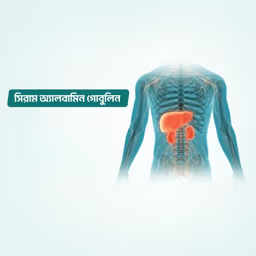
The liver, the largest gland of the human body, is located on the right side of your abdomen. The liver helps in maintaining the body's metabolism by plenty of functions. The yield and production of bile from the liver are essential to carry out and excrete the waste product from the body. The liver clears toxic substances, drugs or other poisonous substances and resists the development of infection.
The two most common enzymes to take the upper hand in liver functioning are:
AST: Aspartate aminotransferase, also known as serum glutamic-oxaloacetic transaminase (SGOT)
ALT: Alanine aminotransferase, also known as serum glutamate-pyruvate transaminase (SGPT)
AST test results and other liver function tests can help doctors screen, diagnose and monitor liver diseases effectively.
In accordance, the SGOT (AST) test, a liver function test, measures the AST or SGOT enzyme in the blood. Under normal conditions, low levels of AST are seen in the liver (majorly), muscular tissues, red blood cells, pancreas, kidney and heart. Whenever there is damage to these organs, specifically the liver, the amount of AST or SGOT enzymes markedly increases as they leak into the bloodstream and show up on the SGOT (AST) test reports. AST test is often conducted with due consideration of ALT levels too. Their ratio (AST:ALT) can help assess liver damage at a precise scale.
India faces the challenges and burden of liver disorders with an increasingly westernised lifestyle. A sedentary lifestyle, accumulation of fat, or chronic alcoholism are the causative agents behind the increase in liver diseases in India. The four stages of liver failure take the course of inflammation, scarring or fibrosis, cirrhosis and end-stage liver disease.
Consumptions of certain medications, biological agents like viruses and genetics are also linked with liver disorders. There is no cure for liver cirrhosis. SGOT (AST) test is used in the diagnosis of liver failure at an early stage. It not only prevents end-stage liver failure but also increases the chance of getting treatment with proven results.
Other names for SGOT (AST) test
Aspartate Aminotransferase Test
SGOT Test
AST Test
Serum Glutamic-Oxaloacetic Transaminase Test
Aspartate Transaminase Test
What does the test detect/measure, and who is this prescribed for?
The liver contains both AST and ALT enzymes. Aspartate Aminotransferase Test, abbreviated as AST test, helps estimate the severity and prognosis of liver disease or failure. The SGOT (AST) test procedure catches an increase in AST enzymes in blood and reflects in the SGOT (AST) reports. If done along with ALT, it is an effective test to screen the outbreak of hepatitis (inflammation of the liver).
The SGOT (AST) tests can diagnose:
Liver-related abnormalities
Non liver-related abnormalities
Potential liver damage
Infective or viral hepatitis
Fatty liver (Steatohepatitis)
Abscess in liver
Circulatory collapse of liver
Liver trauma
Liver cirrhosis
End-stage liver disease
Liver cancer
Inflammation of pancreas, known as pancreatitis
Heart problems
An SGOT (AST) blood test is prescribed to those experiencing symptoms of liver dysfunction, like:
Jaundice: Yellowish discolouration of eyes, skin and mucous membrane
Excretion of dark-coloured urine and light-coloured stool
Abdominal cramps, appetite loss and weakness
Nausea, vomiting and diarrhoea accompanied by fatigue
Accumulation of fluid and thus swelling of legs and abdomen
Hepatitis, Liver cirrhosis, Liver carcinoma, Heart Attack
Your healthcare professional will help you to understand the values. The normal range for SGOT (AST) test are:
Age
Normal Range in units per liter (U/L)
Adult Male and Female
17-59 units/L
Elderly
Slightly higher values than adult
Children
0-5 days year old
35-140 units/L
Less than 3 years old
15-60 units/L
3-6 years old
15-50 units/L
6-12 years old
10-50 units/L
12-18 years old
10-40 units/L
Your doctor will inform you about the medications that might cause elevated AST levels. They are:
Statins
Barbiturates
Herbal supplements
Human immunodeficiency virus medications
Values vary from laboratory to laboratory. No AST level is considered “normal” to all. Your healthy AST might change as you age, exercise, modify your lifestyle, race, sex, etc. In addition, strenuous exercising, muscle trauma and Vitamin A overdose can cause increased levels of SGOT (AST) than normal ranges and in pregnancy, decreased levels.
Test result interpretation
The SGOT (AST) test results can help yield information about rising levels of aspartate aminotransferase in an individual, irrespective of age and gender. Interpretation of AST levels goes as follows:
Very high AST levels than the normal range
An excessively high AST report, i.e., ten times higher than typical values, can indicate any of the following severe liver diseases:
Acute viral hepatitis (inflammation of the liver)
Liver intoxication due to drug overdose, especially acetaminophen
Liver cirrhosis, i.e., irreversible scarring and fibrosis of liver tissue
End-stage liver failure
Tumour necrosis
Moderately high AST levels than the normal range
Moderately high AST levels can help the doctor diagnose liver conditions like:
Cholestasis: A decreased flow of bile from the liver
AST can also rise in heart attack and failure
Muscle trauma
Muscular dystrophy: Progressive loss of muscle mass leading to weakening of the body
Pulmonary embolism
Slightly raised levels of AST than the normal range
It is believed that persistent and slightly elevated levels of AST and ALT cause more harm than one-time raised AST levels. Chronic alcoholism is the primary cause behind the slow and continuous rise of liver enzymes in the blood. It can lead to the diagnosis of:
Liver cirrhosis
Infectious Mononucleosis: An infectious disease that spreads via saliva, also known as kissing disease
There are other considerations to keep in mind while interpreting the results of SGOT (AST) levels. High AST levels alone might not prove out to be a specific diagnostic marker for liver diseases. There are cases observed where patients with Hepatitis C showed normal AST levels. Since the ALT enzyme is more liver-specific, one should measure AST levels and ALT levels simultaneously.
The AST (SGOT) test results analyse a blood sample collected from the arm's vein.
Test preparation
Before the test
Your doctor will most likely prescribe a liver panel along with an SGOT (AST) test. Here are some considerations you will have to take:
If the AST test alone is being tested, you do not require to fast before the test.
If the doctor prescribed other liver function tests along with AST, you need to undergo an 8-12 hour fast before the test.
Inform your doctor about over the counter (OTC) medications, drugs, and any herbal supplements you currently are on.
During the test
A nurse or phlebotomist will use your arm's vein to collect the blood sample.
After the test
When done hygienically and according to protocol, the SGOT (AST) test procedure poses no serious threats to an individual.
Test inclusions: What parameters are included?
SGOT (AST) test reports indicate the extent of damage to liver cells. An AST test, when combined with ALT test and several other liver function tests, accounts for:
Detection of any liver dysfunction
Confirmation and establishment of a diagnosis
Detection of the severity of liver damage
For screening, monitoring and prognosis of liver disease
SGOT (AST) test is one of the essential biochemical parameters of liver function tests (LFTs). Other biochemical parameters to assess the healthy functioning of the liver includes:
Tests based on excretory function, like serum bilirubin, bile salts, etc.
Tests based on the detoxifying function of the liver, like blood ammonia.
Tests based on synthesis function, like plasma proteins and prothrombin.
Tests based on enzymatic function, like AST, ALT and ALP tests.
Metabolic function tests of the liver.