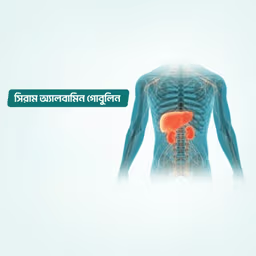
Fibrinogen is a protein that forms fibrin when acted upon by thrombin (an enzyme). In this process, a “fibrin clot” is formed. Fibrinogen is formed in the liver.
The fibrinogen test is done whenever there is a deficiency of fibrinogen or factor I. This may be due to a number of reasons. The test involves the measurement of values of the clotting factor present in the blood.
This test is done by the measurement of fibrinogen activity. The method used is known as the Clauss Method. It determines the fibrin polymerization function. The rate of formation of the blood clot is measured in this test.
It measures the ability of fibrinogen to produce a fibrin clot. This test is basically a fibrinogen assay, which means that it is quantitative in nature.
The clotting ability of the given blood sample is compared with standard or known values of clotting time, which forms the functional assay.
What is a fibrinogen test?
Normally, when an injury occurs at any particular site, the process of healing via clot formation begins. This is a process of achieving homeostasis. Several small fragments of platelets aggregate or clump at the site of the injury, and thereby, the clotting factors are activated one after the other in a “cascade” type of mechanism. A fine meshwork of fibrin is formed in this area when fibrinogen is acted upon by thrombin.
The process explained above is what is measured during a fibrinogen test.
Why is it prescribed?
It is prescribed to detect medical conditions that cause excessive bleeding or deficiency of factor I.
These conditions include excessive bleeding, excessive bruising, getting nosebleeds very often, bleeding of the gastrointestinal tract, the presence of blood in urine, stool, internal bleeding, splenic rupture, etc.
1 in 10,000 people in India suffer from a case of some kind of coagulopathy, that is, a bleeding disorder, where normal blood clotting is impaired. Thus, a fibrinogen test or a test for all or any of the clotting factors will help in the diagnosis of the clotting disorder.
Other names of fibrinogen test:
Hypofibrinogenemia test
Serum Fibrinogen test
Factor I
FIB
Plasma fibrinogen
What is a fibrinogen test used to detect?
A fibrinogen test is used to diagnose the following conditions:
Disseminated Intravascular Coagulation (DIC)
In Disseminated Intravascular Coagulation, abnormal clumps form inside the blood vessels. Due to this, an excessive amount of clotting factors are used up.
Fibrinogen deficiency
This is an inherited condition. It is a rare condition in which blood doesn't clot normally due to deficiency or lack of protein fibrinogen.
Fibrinogen storage disease
In this condition, there is an excess of fibrinogen formation and it gets accumulated in large quantities in the liver, thereby damaging it.
Congenital afibrinogenemia
This is also an inherited condition. There is a lack of factor I.
Congenital dysfibrinogenemia
It is an inherited disorder. Levels of fibrinogen are normal, but its functioning is poor, which causes abnormal bleeding.
Cirrhosis
In patients suffering from severe liver cirrhosis, there are decreased levels of fibrinogen because it is constantly being used up, as cirrhosis is a degenerative disease.
Fibrinolysis
There is a breakdown of normal clots in this condition.
Liver failure
Due to the breakdown of clotting factors in liver failure, there is low content of fibrinogen.
Although fibrinogen disorders occur in both males and females, they are more adverse in female patients.
In women, the following problems may be encountered:
Afibrinogenemia (there is an absence of fibrinogen).
During menstruation, there may be heavy bleeding if the female patient is suffering from a fibrinogen disorder.
This may be especially problematic during pregnancy. Women afflicted with fibrinogen could suffer miscarriages, especially between the 5th and the 8th week of pregnancy.
There may be excessive bleeding during parturition (childbirth).
Disseminated Intravascular Coagulation (DIC), Factor I deficiency (Fibrinogen deficiency), Congenital fibrinogen deficiency
Normal Adult
200-400 mg/dL or 2-4 g/L
Mild hypofibrinogenemia
150 - 200 mg/dl in adults
Moderate hypofibrinogenemia
100 - 150 mg/dl in adults
Critically low value
< 100 mg/dL
Newborn
125-300 mg/dL
Test result interpretation
Consistently low levels of fibrinogen may be indicative of an inherited disorder, such as congenital afibrinogenemia, congenital dysfibrinogenemia or congenital hypofibrinogenemia. In these disorders, there is a deficiency of the clotting factor.
Acquired conditions such as Disseminated Intravascular Coagulation (DIC) may cause low levels of fibrinogen.
Severe liver disease may also be a cause of low levels of fibrinogen.
Abnormal fibrinolysis occurs due to coagulopathies when the body is actively breaking down clotting factors.
Low levels of fibrinogen may also occur after massive blood transfusions.
Some drugs induce a low level of fibrinogen in the blood. This might not be a major cause for concern.
Decreased fibrinogen levels associated with Afibrinogenemia, Hypofibrinogenemia, End-stage liver disease and severe malnutrition are categorised under chronic conditions.
Decreased fibrinogen levels associated with Disseminated Intravascular Coagulation (DIC), fibrinolysis, and large-volume blood transfusions are categorised under acute conditions.
A sample of blood is withdrawn from a vein in your arm using a needle.
Test Preparation
No special test preparation is required prior to testing. The usual way to collect a blood sample is by drawing it from one of the veins of the arm. This vein is usually the most prominent in the forearm of a person. This procedure lasts for 5 minutes.
Test Inclusions: What parameters are included?
A fibrinogen test measures the activity of the clotting factors present in the blood, in which the fibrinogen, which is soluble, is converted into mesh-work-like fibrin threads. It measures the time that is needed for this clot formation to take place. This is influenced by the thrombin that acts on the fibrinogen like an enzyme in this process.
Prolonged clot formation indicates decreased levels of fibrinogen or dysfunctional fibrinogen, meaning that the clotting factor is not working as it should, as per the normal requirements of the process.
Dysfunction of fibrinogen occurs in the following conditions:
Bruises
Epistaxis, which means bleeding from the nose
Bleeding of the gastrointestinal tract
Haemorrhage of the genito-urinary tract
Intracranial bleeding, which means bleeding inside the cranium or internal bleeding inside the skull
Splenic rupture and haemorrhage in the spleen
An increase in fibrinogen levels occurs due to the following conditions:
Heart diseases
Infections
Cancerous conditions
Inflammatory disorders
Traumatic injuries
Heavy smoking
Thus, a fibrinogen test takes into account the following two things:
Hypofibrinogenemia
This means that the levels of fibrinogen or factor I in the blood are lower than the normal range.
Dysfibrinogenemia
This means that there is improper functioning of the fibrinogen.
How frequently should you take this test?
This test is not done routinely. It is prescribed only when some kind of coagulopathy is suspected.
This test should be performed when patients present with cases of excessive bleeding, bruising, frequent nosebleeds, bleeding from the gums, etc. It should be done when bleeding disorders run in the family because they are hereditary.