
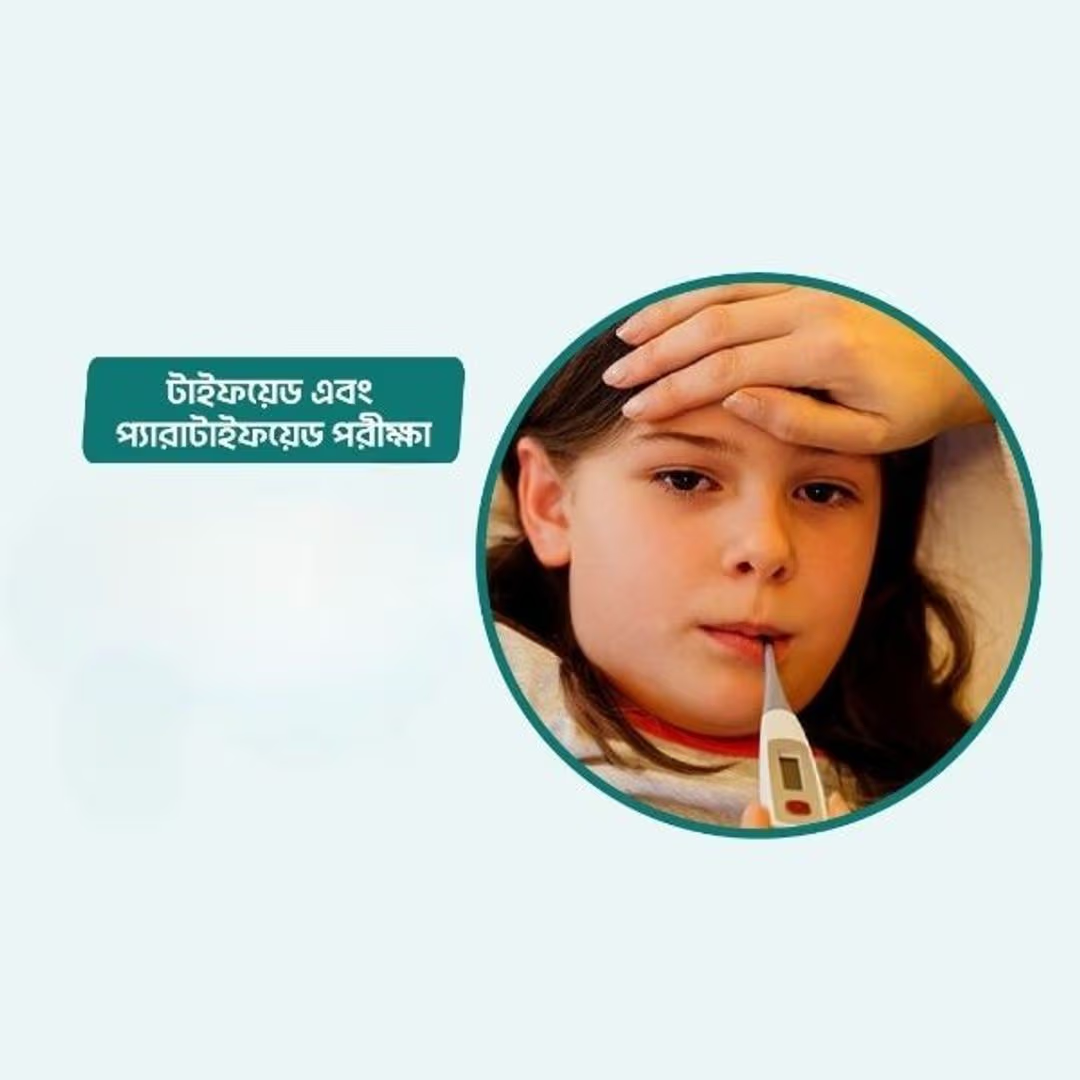
Report in 12 hours
Booked 19 times
Typhoid and Paratyphoid Test
Comprehensive Insights through Typhoid and Paratyphoid Testing


Sample Type
blood
Fasting Required
No
Description
Your health care provider may suspect typhoid fever based on your symptoms, and your medical and travel history. The diagnosis is often confirmed by growing the Salmonella enterica serotype typhi in a sample of your body fluid or tissue.

Covid Safety
Assured

Free Report
Counselling
Recommended for You


How our test process works!

The Typhi IgM Test typically aids in the diagnosis of antibodies directed against the Salmonella Typhi outer membrane protein. The whole Typhidot test is typically administered along with the Typhi IgM test. A dot ELSA kit for detecting IgM and IgG antibodies is part of this test. The infection takes two to three days to get positive findings on the typhidot test. It also distinguishes between the IgM and IgG antibodies individually.
The findings of an IgM test can be used to identify a recent infection in the body. IgG, on the other hand, aids in the diagnosis of any distant illness within the body. The Typhi IgM findings' biggest drawback, meanwhile, is that they are only positive or negative and lack quantitative data. However, getting a detailed test of Typhi IgM can help understand the specific antibodies present in the body.
Typhoid fever can be identified with the test. It is a highly prevalent ailment, and prompt diagnosis is crucial. Typhoid fever is brought on by several bacterial strains that are resistant to several drugs. There are links between this infection and both morbidity and mortality. In actuality, there is a chance that improper diagnosis and therapy will go untreated, which could result in fatalities.
In addition to aiding the patient, a correct diagnosis of typhoid fever is necessary to track down and treat possible carriers as well as stop fatal outbreaks of the disease. It is true that the first antibodies that rise in response to lipopolysaccharides O are IgM. A indication for recent infection is the presence of IgM antibodies specific to S. Typhi rather than IgG.
Typhoid fever's initial signs and symptoms include weakness, exhaustion, headache, perspiration, aches and pains in the muscles, stomach pain, rash, dry cough, appetite loss, and weight loss. It is necessary to get a Typhi IgM profile test if you experience any of these symptoms.
It's a good idea to see a doctor and have the full Typhidot test right away if you have even the slightest uncertainty. Typhoid fever can be diagnosed at any stage with the aid of the Typhi IgM profile test.
If you experience stomach pains, a Typhi IgM test is also recommended. Additionally, your doctor may advise you to do the test if you have a rash on your body and severe constipation.
Typhoid fever is a serious health issue in India and is prevalent there by nature. Food and water pollution is the root cause of it. It is discovered to be common in situations with really poor hygiene. States like Maharashtra, Rajasthan, Delhi, and certain regions of Gujarat are frequently impacted. In slum areas, typhoid fever is more common.
Other names of the Typhi IgM test
Typhi antibody test-IgM
Typhidot test-IgM
Salmonella Typhi IgM
Typhidot test
What does the test detect or measure and who is it prescribed for?
The Typhi IgM test detects the presence of antibodies against Salmonella typhi due to a recent infection in the body.
The early symptoms for which your consulting physician will prescribe the Typhi IgM test include:
Muscle aches
Headache
Dry cough
Sweating
Diarrhoea or constipation
Rash
Loss of appetite resulting in weight loss
Fever that increases gradually over the days
Stomach pain
If proper treatment is not given, the patient can become delirious and lie motionless and exhausted with eyes half-closed. This is known as the ‘typhoid state’. Also, life-threatening complications can develop over time. However, it is important to take the follow-up Typhi IgM test as the symptoms can resurface in two weeks, even if the fever has subsided.
The results of the Typhi IgM test will help the doctor diagnose your condition. If some of the antibodies are still present in the blood, the doctor will continue with a course of medication.
The Typhi IgM Test is applicable for all genders, both young adults and children.

Typhoid Fever, Typhoid

The Typhi IgM is a qualitative test result that is not presented as ranges; it is either positive or negative. However, the normal range of IgM present in the body should be 0.4-2.5g/L for both men and women.

Reports of antibodies and recent infections in the body are provided by Typhi IgM. A positive Typhi IgM test result indicates the presence of an infection in your body. Nonetheless, in order to make a typhoid diagnosis, the physician may recommend that you undergo additional testing, such as the Typhi IgG test, Widal test, urine culture, stool culture, and blood culture.
The Salmonella typhi outer membrane protein is the target of the production of IgM antibodies. Antibodies to IgM are calculated individually.
A positive Typhidot IgM test indicates a recent Salmonella typhi infection. Typhoid fever is caused by this bacteria.
A negative Typhidot IgM test results in the absence of Salmonella typhi infection.

The result of a Typhi IgM test is based on the analysis of a blood sample. The test will detect your antibodies with a single sample.
Test preparation
The Typhi IgM test is a blood test that does not require fasting or any specific preparation. However, inform your doctor about any medications you are taking so that they do not affect the results of the Typhi IgM test.
During the test procedure, the lab technician will place a tourniquet or elastic tightly on your upper arm. You will then be asked to make a fist to facilitate the buildup of blood in the veins. The area of skin is then cleaned and the blood sample collected with a needle inserted in a vein of the arm.
Test inclusions: What parameters are included?
The Typhi-IgM test detects the antibodies against Salmonella typhi. It does not have any fixed range or parameters as the test result is either positive or negative. The result of the Typhi IgM profile test detects a recent infection in the body.
However, this test alone cannot detect every aspect of the infection in detail. You will also have to take the Typhi IgG test to diagnose any remote infections in the body. After that, the doctor will be able to give you proper treatment and medication.
Frequently Asked Question
With five or six subunits, it is a protein with a high molecular weight. Disulfide bridges bind the two light and heavy chains that make up the monomers of IgM together. The concentration of IgM monomers in human serum is comparatively lower. After the first exposure to the pathogen, the system develops this antibody initially. Put simply, it aids the body's defense against infections caused by bacteria, viruses, and other pathogens. Its other roles include immune modulation and immunological tolerance. Additionally, by triggering the complement system, it attaches to the antigen.
Typically, the IgM antibody develops as soon as the body comes in contact with the infection. However, it can take up to 4 weeks for the IgM antibodies to completely develop in the system. Also, they do not last for very long in the body. They are in the system for 3 to 10 days.
IgM is the first antibody type that a foetus produces after 20 weeks of synthesizing. It cannot cross the placenta. It is the first immunoglobulin class produced against the antigen as a primary response. However, the IgM antibodies are relatively short-lived as compared to IgG.
The doctor will ask you to take this test if they suspect typhoid. Later, you will have to retake the test 1 or 2 times based on your recovery. This is done to monitor the effectiveness of the medications. Also, you will have to take the Typhi IgM profile test after you have recovered to make sure there is no lingering infection in the body.
Report in 12 hours
Booked 19 times
Typhoid and Paratyphoid Test
Comprehensive Insights through Typhoid and Paratyphoid Testing


Offered by other labs
Sample Type
blood
Fasting Required
No
Description
Your health care provider may suspect typhoid fever based on your symptoms, and your medical and travel history. The diagnosis is often confirmed by growing the Salmonella enterica serotype typhi in a sample of your body fluid or tissue.
Covid Safety
Assured
Free Report
Counselling
